The hard part of putting AI into financial advice was never teaching a machine to talk. It's knowing the exact moment a helpful answer turns into a recommendation.
That line, the one between guidance and regulated advice, is where the whole industry is now standing. The FCA's recent review of AI in retail finance put a marker down: AI will reshape how people get financial help by 2030, and it's already further along than most firms assume. Around a quarter of consumers say they already trust AI tools for financial guidance. Close to one in five UK adults, roughly eleven million people, are likely to use agentic AI for money decisions, and the appetite is strongest exactly where the stakes are highest: pensions, investments, and debt.
So this isn't a question for 2030. People are already asking machines what to do with their money.
Here's why the boundary is the hard part. For a human adviser, the line between "here are your options" and "here's what you should do" is a judgement call. It's made consciously, case by case, by someone trained to know which side of it they're on and what changes when they cross. Targeted Support, live since April 2026, was designed to give firms room to help people right up to that line without the full cost of regulated advice. It widened the space firms can operate in. It didn't make the line any easier to see.
Now hand that same judgement to an agent answering thousands of questions a day. "Cash ISA or investment ISA?" looks like a simple guidance question. The answer can quietly become advice in a single sentence, without anyone deciding it should. Multiply that across every conversation, every day, and you have a system that can cross a regulatory boundary at a scale no compliance team can sample after the fact. Often nobody knows until a regulator looks back.

Most of the response to this has focused on the wrong half of the problem. The instinct is to police how the agent talks. Guardrails on tone, filters on phrasing, checks that the conversation sounds compliant. That work matters, and firms doing it well have earned their place. But in advice, sounding compliant and being right are different things. You can assure the conversation and still have no idea whether the recommendation underneath it was suitable for the actual person. Assuring the chat is not the same as assuring the advice.
The FCA's review also raised a sharper version of this. It asked whether general-purpose AI assistants, the everyday chatbots millions of people already use, should fall inside the regulatory perimeter when their answers start to look like advice. However that question is resolved, it makes the same point from the other direction: the risk isn't the interface. It's the moment the output starts doing a regulated job.
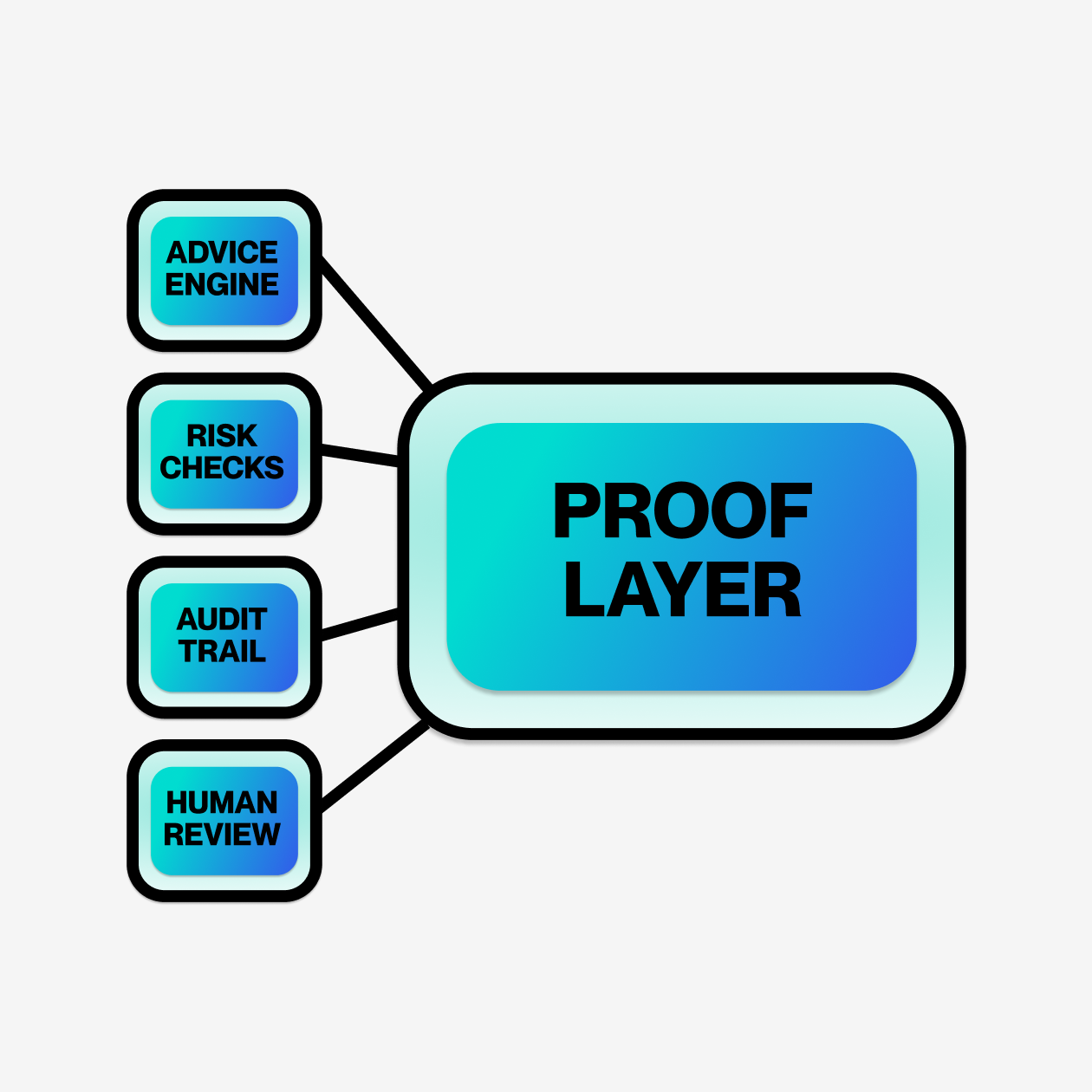
This is the problem we've spent nearly a decade building for. Not the wrapper around advice, but the advice itself. We were the UK's first FCA-authorised automated advice platform, and from the start the boundary wasn't a warning bolted on at the end. It's built into how a recommendation is produced. The system knows where the line sits and holds it the same way every time, because the logic that turns a person's circumstances into a suitable next step is deterministic. The same inputs produce the same auditable output, every time. We use probabilistic AI where it genuinely helps, in the conversation and the interpretation, and keep it away from the decision itself. And we check the whole case, not just the transcript, so the fact-find, the recommendation, and the reasoning that connects them are assessed together.
None of that shows up in a demo. All of it shows up the day a regulator asks why a particular answer was given to a particular person.
Whatever firms take from the review, the takeaway won't be that agents need to talk better. They already do. The hard part, the part worth building properly, is knowing the precise moment a helpful answer became a recommendation, and being able to prove you knew.