
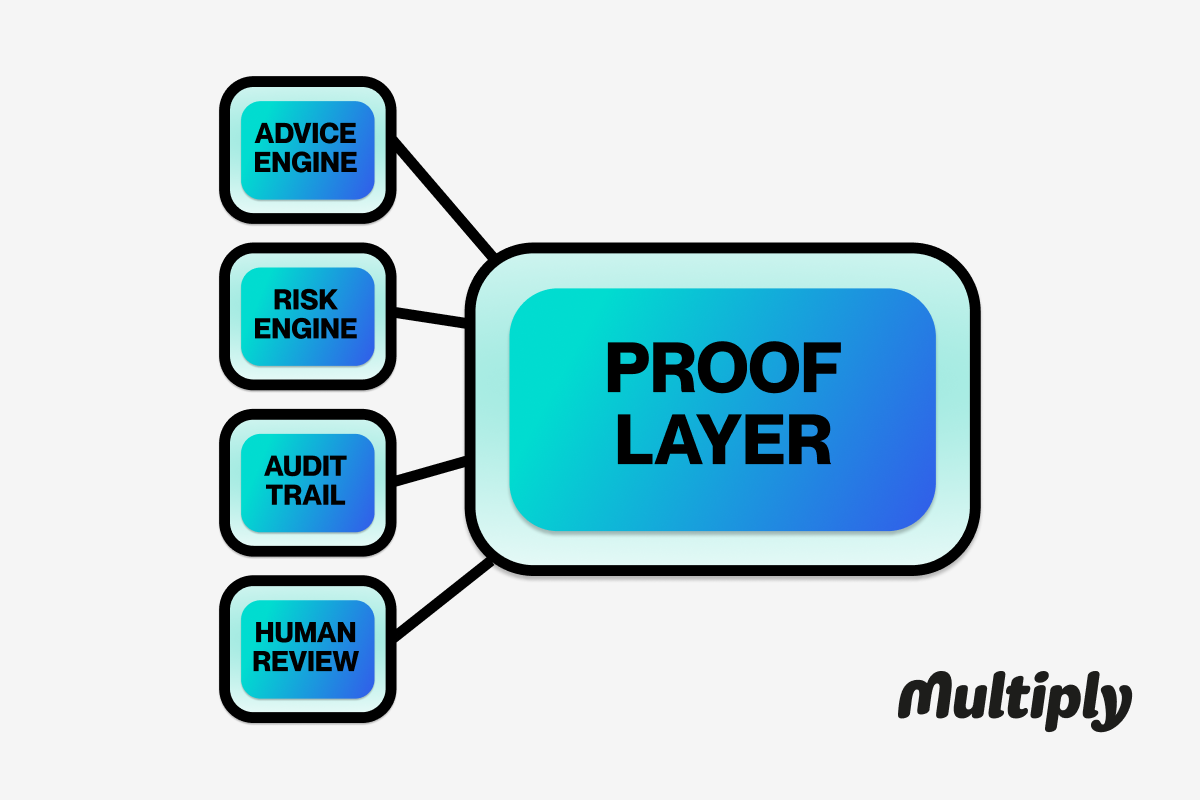
There's a pattern we've watched repeat across the market this year, and it's worth saying plainly. Automated advice isn't won at the demo layer. It's won in the proof layer. Building an advice engine that demos well is only half the problem. Proving it can be trusted, case after case, is the half that decides whether a system survives contact with real clients, real compliance teams and real regulatory scrutiny.
It usually starts well. A platform with a strong engineering team builds the parts that demo brilliantly. A natural language fact-find. A rules-based suitability engine. A report generator that produces something polished in seconds. The client-facing experience feels intelligent, and the early demos land. That's the half of the problem that's visible, fundable, and satisfying to build.
Then the questions arrive that don't have a front-end answer. How do you prove every recommendation was suitable? How do you catch the edge case before the regulator does? How do you give a compliance officer a view across thousands of automated cases without burying them in manual review? This is the proof layer, and it turns out to be where the real work lives.
We see the cost of underestimating it in public occasionally. We've watched high-profile advice technology projects struggle, and some get abandoned, when the operational and compliance layer proves harder than the front-end experience. It's tempting to read each as a one-off. We read them as a lesson about where the effort really needs to go. The interface is a known quantity. The advice underneath it, the suitability logic, the audit trail, the proof that holds up a year later, is the part that's hard to scope and expensive to retrofit.
There's a deeper reason the proof layer resists a quick build. When humans give advice, quality assurance is about individual performance, so sampling a few cases makes sense. When a system gives advice, the risks are structural. A model that drifts. A fact-find that contradicts the suitability report. A vulnerability mentioned in one document and addressed in none. Every individual interaction can pass while the case as a whole fails. Checking the conversation is not the same as checking the case.
This is why the intelligence in regulated advice isn't only in the recommendation. It's in how the fact-find, the recommendation logic, the suitability rationale, the evidence, the risk checks, and the human approvals connect into one governed case. Any one of those can be built on its own. The hard part, and the real moat, is joining the engine, the governance, and the workflow into a single system that holds together.
It also has to be deterministic where it matters. The same inputs producing the same auditable output, every time, explainable to a regulator, a compliance officer, or the client themselves. Probabilistic AI is right for the conversational and interpretive work. It isn't right for the recommendation itself. Knowing which parts of the system need which, and being able to prove it, is the difference between something that feels intelligent and something that holds up.
We built it the other way round from most. Deterministic advice logic first, the experience on top, and the compliance and quality layer designed in from the start rather than added at the end. That ordering comes from having done this in production for nearly a decade, as the UK's first FCA-authorised automated advice platform, with the edge cases learned over time rather than discovered late.
The AI story in financial services keeps being told as a product problem. The firms treating it as a governance problem, and building the proof alongside the engine, are the ones whose systems will still be standing when someone asks them to show their working.
Building something that works in a demo was never the hard part. Building something that holds up when it's questioned is the work. That's the difference between adviser efficiency software and regulated advice infrastructure.


